Posts

Showing posts with the label Antique Jewelry

Antique Tuesday - Plique a jour - Art Nouveau

Image
Circa 1890 - Retail Value $25,073 Today we are looking at 3 pieces of Art Nouveau Period Circa 1890 to 1905 Plique-a-jour jewelry. Circa 1900 - Retail Value $4,405 Plique-à-jour, (French for "braid letting in daylight"} is a vitreous enameling technique where the enamel is applied in cells, similar to cloisonne, but with no backing in the final product, so light can shine through the transparent or translucent enamel. It has a stained-glass like appearance and is considered very challenging technically. (From: Wikipedia ) Circa 1900 - Retail $2,914 This example below shows the back of the pendant/pin from the top of the page. Sorry about last week everyone.  I have been super slammed with deadlines.  I will do my best to publish "Antique Tuesday" each week.  Sometimes it maybe only twice a month.  I hope you enjoyed this weeks post. Please visit Adin Fine Antique Jewelry to see other fabulous jewelry!

Antique Tuesday - Victorian

Image
Victorian  Combo Jewelry This week for Antique Tuesday I am featuring Victorian combination pendant/brooch jewelry.    Circa 1880 - Retail Value $5,058 The 1880 Griffin brooch/pendant above shows how the clasp actually unscrews to transform into a pendant.       Circa 1890 - Retail Value $2,862    In this Victorian diamond rose cut piece the bale folds up to be worn as a pendant or down for a brooch. Circa 1850 - Retail Value $7,920 Thanks to a discreet placed system in the back, the parts that enable this jewel to be worn as a brooch or pendant can be easily switched. Once again, I would like to thank Adin Fine Antique Jewelry for use of their photos and information.  Please visit their site for more examples. 

Antique Tuesday - Victorian

Image
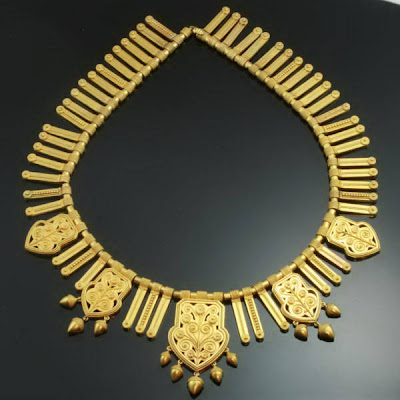
A touch of history ... Victorian gold archaeological-revival necklace attributed to Fontenay. Circa 1870 - Retail Price $33,548 The continuous uniform fringe decorated with beads, wirework and florettes of this necklace is typical for the work of Eugène Fontenay. A demi-parure of very similar design is illustrated in French Jewelry of the Nineteenth Century, Henri Vever, translated by Katherine Purcell, p. 643. and a similar necklace plus matching earrings were sold at Sotheby's for $52,000 (Important Jewels auction, New York, February 2008 sale N08410, lot 110).   Eugène Fontenay (1823-87) was one of the foremost goldsmiths in France during the second half of the nineteenth century. He was a great admirer of the ancient techniques of granulation and filigree, and became best known for his outstanding work in the 'archaeological' style. Fontenay was no doubt inspired by the Campana collection of ancient jewelery, acquired by Napoleon III in 1860, and his ...

Antique Tuesday - Art Deco

Image
Please note this bracelet is Art Deco STYLE - Circa 1955 - Retail Value $30,733   The Art Deco style is a very famous and popular art movement that had a lot influence in the world of jewelry. Art Deco was introduced in the 1920s as protest against the Art Nouveau style. Art Deco ended in the 1930s. The style emphasized a very abstract design with geometric patterns and as most favorite colors: black (onyx), blue (sapphire), green (emerald), white (diamond) and red (coral). The baguette and emerald-cuts, which had been developed in the nineteenth century, where very popular in the 1920s because they blended so much with the geometrical lines of the Art Deco style .  Circa 1930 - Retail Value $2,606 Most of the Art Deco jewelry has a very luxury design. This is because of the large amount of money that was made in the war of 1914. All this money gave the opportunity to buy the best fashionable materials like: diamonds, platinum, red gold and yellow gold for ...

Antique Tuesday

Image
Georgian Mourning Jewelry Each week I pick an interesting piece of antique jewelry from Adin Fine Antique Jewelry to share with you.  This week I am featuring this precious and highly emotional Georgian mourning ring.   Circa 1792- Retail Value $4,532 Georgian Period spans between 1714 and 1837.  During this time there was great political upheaval during the reigns of four English Kings named George.  Mourning jewelry was common during this period.  People often made jewelry with a lock of hair from a loved one.  We have seen the names and dates on tombstones but they rarely move us.  This little ring is not the most impressive piece at first  glance but turn it over.  Read the engraving and suddenly you are transported to a tragic moment 200 years ago…the inscription in the ring reads:  W.A. aged 4 Yrs died 6 July 1792 G.R.A. aged 4 Mo's died 12 Dec 1792   Then take a look at the top of the ring again a...

Antique Tuesday

Image
Tips - How To Date Earrings   Adin Fine Antique Jewelry Circa 1830 - Retail Value $2,564 When dating a pair of vintage or antique earrings, the first clue that you will look at are the earring findings.  These findings can be dated and will indicate when the earrings were made.   Please note that antique wires can break.  There are many pieces that have been updated/repaired.  The earrings can actually be older than the finding portrays.  If you have a similar situation you will need to refer to the motifs, materials and embellishments to date the piece.  Please look at ear clips below as an example.  The entire earring should be taken into account when dating a piece.   F ish hook or Sheppard Crook earring findings are the earliest type of ear wire.   Adin Fine Antique Jewelry - Fish Hook Circa 1750 - Retail Value $4,799 Kidney wires are very popular today and have been traced back to the 1870's.  Adin Fine Antique...

Georgian & Victorian Seed Pearl Jewelry

Image
Back in the 90's before I started to design jewelry, I longed to be an antique appraiser. I love all types of antiques and collectibles. I wanted to be able to value and date my fabulous finds. My collections consist of sterling & plated silver, brilliant cut glass, furniture and of course jewelry. To achieve this goal I attended the College of Appraisers in Placentia, CA (I believe the school is no longer located there. The owners have since passed away). It took me two years to complete the appraiser certificate program. Although I do not appraise for a living, the knowledge gained attending the classes were priceless! Seed Pearl Jewelry was handmade during the last quarter of the 18th century to the end of the 19th century. A seed pearl is a natural pearl that weighs less than a quarter of a grain. The diameter is less than 2 mm. Can you imagine someone drilling a hole in these tiny treasures? A mother of pearl backing is used to attach the pearls with blond hors...