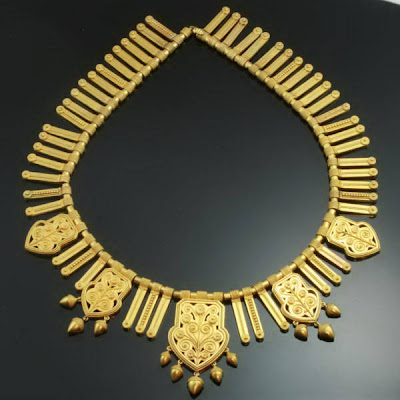
A touch of history ... Victorian gold archaeological-revival necklace attributed to Fontenay.
 |
| Circa 1870 - Retail Price $33,548 |
The continuous uniform fringe decorated with beads, wirework and florettes of this necklace is typical for the work of Eugène Fontenay. A demi-parure of very similar design is illustrated in French Jewelry of the Nineteenth Century, Henri Vever, translated by Katherine Purcell, p. 643. and a similar necklace plus matching earrings were sold at Sotheby's for $52,000 (Important Jewels auction, New York, February 2008 sale N08410, lot 110).
Eugène Fontenay (1823-87) was one of the foremost goldsmiths in France during the second half of the nineteenth century. He was a great admirer of the ancient techniques of granulation and filigree, and became best known for his outstanding work in the 'archaeological' style. Fontenay was no doubt inspired by the Campana collection of ancient jewelery, acquired by Napoleon III in 1860, and his firm produced much work in the antique style based on Greek, Roman and Etruscan examples.
 |
| Back of Necklace |
Eugène Fontenay, son of goldsmith Prosper Fontenay, founded his own workshop on the rue Favart, Paris, in 1847. By the 1850s he had achieved considerable success, culminating in the execution of a tiara for the Empress Eugènie in 1858. However, it is his work of the 1860s for which he is most renowned. Called the "archaeological style," Fontenay's pieces were influenced by ancient Greek, Roman, and Etruscan examples, and were certainly inspired by the 1860 arrival in Paris of the Campana Collection, ancient jewelry purchased by Napoleon III. In addition to exquisite gold work, Fontenay collaborated with the enamelist Eugène Richet on a series of jewelry containing enameled plaques which employed antique themes and an antique style. He received a gold medal at the 1867 Paris World Exhibition for his work in this style, and counted among his many prominent clients the Viceroy of Egypt, the Shah of Persia and the King of Siam.
I hope you enjoy today's "Antique Tuesday".